
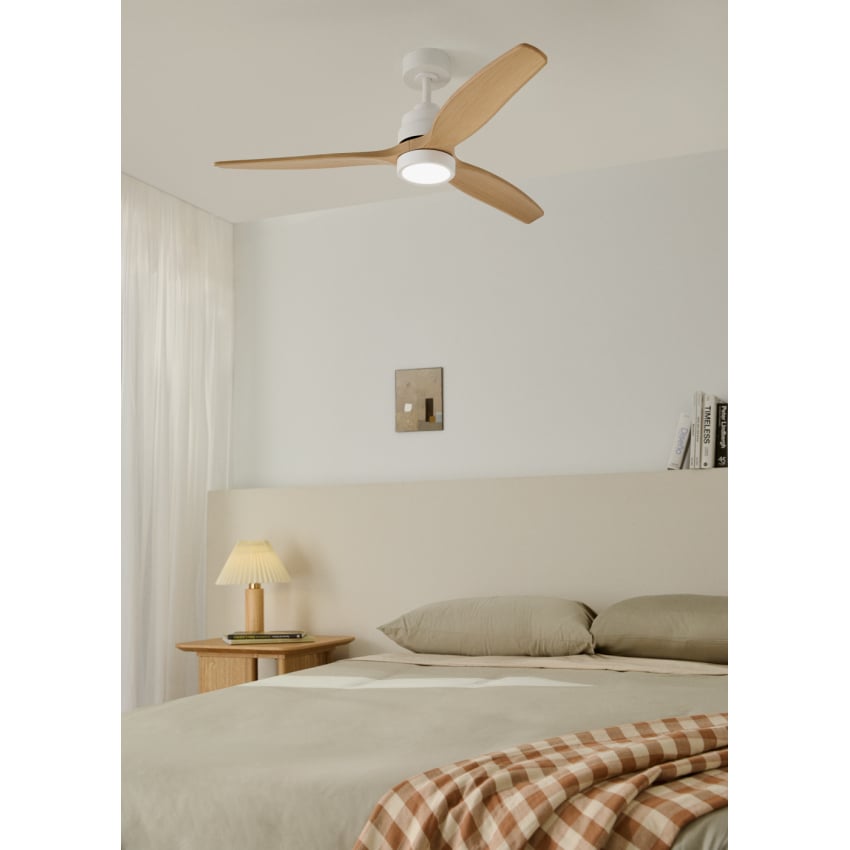
Every summer the same question comes up: is it worth leaving the air conditioning on all day, or is a fan better? The short answer is you don’t have to choose one or the other: the trick is combining them well. Here’s the difference in running cost between the two, and how to get the most out of using them together on the hottest days.
How much each one actually uses
A standard room air conditioning unit can draw somewhere between 1,000 and 2,500 W depending on the unit and the outdoor temperature. A DC-motor ceiling fan, on the other hand, runs on a completely different scale: models like the WIND CALM or WIND STYLANCE we regularly install use a 40W motor, and the more compact model for small rooms, the Beach S by Inspire, uses just 26W. The gap in power between an air conditioner and a ceiling fan is several orders of magnitude: the fan uses a tiny fraction of what the AC draws per hour of use.
That doesn’t mean a fan actually “cools” the air the way air conditioning does. A fan doesn’t lower the room’s real temperature: what it does is move air and create a cooler feeling on the skin, which in practice lets you feel several degrees cooler without the thermometer having moved at all.
Why they don’t compete, they complement each other
Air conditioning does genuinely cool the air, but running it for hours on end drives up consumption fast, especially if the home isn’t well insulated or doors and windows get opened often. A ceiling fan, on the other hand, doesn’t lower the air temperature, but keeps that cooler feeling circulating for much longer at a minimal running cost.
The strategy we recommend most to our clients on really hot days is this:
- Run the air conditioning for just over an hour, with the room door closed, to genuinely bring the ambient temperature down.
- Turn the AC off and leave the ceiling fan running. The already-cooled air stays in motion and that cool feeling lasts considerably longer than it would take the AC alone to achieve the same thing, without the constant draw of the compressor.
- Repeat the cycle only when you notice the temperature creeping back up, instead of leaving the AC running continuously.
With this combination, the electricity bill during the hottest months drops noticeably without giving up comfort, because most of the hours of use are covered by a unit that draws tens of watts instead of thousands.
An extra benefit: it saves in winter too
Models with a summer/winter function, which almost all modern ceiling fans have, spin in reverse during the cold months to push the warm air that collects near the ceiling back down. This helps the heating work less to maintain the same felt temperature at head height, so the investment doesn’t sit idle for half the year: it earns its keep in both seasons.
Our recommendation
If your home already has air conditioning, a well-placed ceiling fan in the rooms where you spend the most time — the bedroom and living room, above all — is the simplest way to cut down AC running hours without noticing the difference in comfort. And if you’re considering doing without air conditioning in a particular room altogether, a quiet ceiling fan with a good airflow is usually more than enough in most bedrooms in the area.
At JaveaFix we help you choose the right model for each room and take care of the full installation, with a clear quote before touching anything.
